Using social media can be difficult, and it can be considerably more difficult if you don’t have a road plan to your final destination. If you’re a business owner who uses social media but isn’t getting the results you want, we’re here to guide you in the correct direction.
To market your business successfully on social media, follow these guidelines:
1. Create a number of profiles
Many businesses prefer to be present on only one social platform since it can be difficult to plan for numerous platforms. While having a Facebook profile is a good start, being present on only one platform will not provide you with the reach and results you desire. To have a strong social media presence, it’s best to be active on numerous channels.
When it comes to building out your profiles, you’ll want to make sure that they represent your business in a professional and engaging way. It all begins with developing usernames that are consistent and immediately identifiable as being associated with your brand.
Make sure to fill out all of the information on these newly established accounts completely, and use the same keywords as you would on your website for an added SEO boost.
Now that you’ve set up your profiles, it’s time to set some goals and objectives, as well as begin tracking your social performance. It’s critical to consider these objectives in the context of your overall marketing plan.
This will make determining the worth of your work on social media and calculating ROI much easier. Begin creating your social media marketing strategy by identifying three social media objectives and the statistic you’ll use to assess their effectiveness.
It will be lot easier for you to come up with content to post that will help you achieve your goals faster once you’ve decided on the purpose of your social media presence and defined your goals.
3. Create a Content Schedule
Now that you’ve decided on your objectives, it’s time to have some fun. Make a list of the kind of material you’ll share on your various platforms. It’s critical to stay active and post relevant, interesting material across all of your networks. Making a calendar and filling it with a mix of content that your audience will love is a terrific way to organize your thoughts and see the month from a macro perspective.
Promotions or deals you’re running, presenting a new product or service, holidays, industry news and announcements, a look at corporate events, and anything else your audience would find fascinating or relatable are all types of content you can include to your calendar.
ECL Ghana | Advertisement
It’s crucial to remember posting best practices for each social media network. For example, if you post too frequently on Facebook, your impressions and engagement will suffer. Whereas on other platforms, if you don’t publish numerous times each day, you won’t reach your target audience. Check your analytics to make sure you’re posting during high engagement periods for each platform, so you can reach as many of your followers as possible.
With pr.business social media packages, you’ll receive a content calendar with your monthly postings, as well as research into your most busy time frames to guarantee that every post you send out receives the attention it deserves.
It’s time to engage with your audience now that you’ve created excellent content with a purpose. Audience interaction was cited by 64% of marketers as critical to their social media marketing approach. Make an effort to participate in the appropriate conversations, as well as monitor and respond to comments and private messages. Don’t let your audience down! This is your moment to create relationships with them.
Every day, set aside time for involvement. Your fans will use your social media sites to ask questions, receive more information, express their affection, and for a variety of customer service purposes. On social media, providing excellent customer service can assist increase revenue, customer satisfaction, and retention.
ECL Ghana | Advertisement
Conclusion
It’s also crucial to identify your voice when you first start engaging, and to maintain a consistent tone when posting and talking with your audience. Maintaining an authentic brand image on social media requires consistency.
Workplace conflict is defined as a condition of disharmony generated by the actual or perceived clash of needs, values, and interests among coworkers. Organizational conflict can take numerous forms.
Over the course of their lives, people spend nearly 10.27 years at work on average. When you spend so much of your time in a setting with so many other people, there is sure to be some conflict. This can sometimes turn into a workplace confrontation.
Let me share a fact and a GIF with you to demonstrate the extent to which any workplace argument can escalate. According to a research from Manage Conflict, more than half of all employees in the workplace are being sued by coworkers. This can burn a hole in your pocket, increasing your stress level by the minute.
There are many different types of people in the workplace who come from various backgrounds. As a result, it is the responsibility of both the employee and the business to ensure that a healthy working environment is maintained and that all disagreements are properly resolved.
Personal actions
1. Take a look at yourself.
Ego is one of the main feelings that distinguishes us from other animals, such as love or empathy. An unrestrained and haughty ego, on the other hand, can be a major source of workplace friction. According to a recent CPP study, workplace confrontations are caused by feuding egos in 49 percent of cases.
As a result, in order to avoid unwelcome confrontation and settle any unavoidable clashes, an employee must always be aware that she or he is coexisting at a workplace with people of various personalities who are at odds with one other for no reason.
ECL Ghana | Workplace Conflicts
2. Make a tone check
Your tone is more accurate than any punctuation in any language in expressing a message. It is, nonetheless, one of the most perspective-driven mediums.
As a result, whether speaking with any of the company’s subordinates, managers, or other employees, everyone should keep their tone in check. This not only decreases the likelihood of disagreements, but it also puts you in your coworkers’ good graces. It also never hurts to be nice.
3. Keep your ears to the ground.
A passionate debate is what a verbal conflict is. So, if you want to lessen the heat, listen to the flame. Any individual can easily end a quarrel by simply listening to what the other party has to say and seeing how it contradicts their own beliefs.
Having this understanding can assist you in finding a happy medium where everyone can be satisfied without losing their minds.
4. Don’t play the blame game; instead, address the issue.
This is one of those tidbits that we’ve been told since we were kids. Blame is a game for the weak. Open-mindedness is required to recognize that the issue is not with the party with whom you are at odds, but with the system and communication. When this is decided, it becomes a relatively simple process because both parties can now focus on the problem and address it according to the managers’/subordinates’ wishes.
Steps to take on an organizational level
Employees spend about 2.8 hours each week on average managing and resolving workplace problems. This, together with the money spent on legal representation, should convince any organization that disagreements are extremely destructive to them.
As a result, every company must ensure that conflict is kept to a minimum, ideally none.
Employees, on the other hand, may not always follow company policies and may lack the necessary control to avoid confrontations. To establish a win-win-win situation for both the quarreling employees and the organization, organizations must attend frequent conflict resolution seminars and workshops.
It is also the company’s responsibility to guarantee that there is healthy interdepartmental communication. This guarantees that everyone is on the same page with the organization’s goals and has a good working relationship with one another.
ECL Ghana | Advertisement
Conclusion
To sum up, after a disagreement has been given time, it is simply a difference of opinion, and we must fix the difference rather than the people who have it. Organizations can also play an important role in keeping a team united and focused on a common objective.
From a positive standpoint, conflict is an inherent side effect of problem-solving, and employing these strategies may surprise you with how quickly disagreements can be addressed when everyone involved keeps their cool and works together to solve the problem.
Tracking traffic can help you understand client behavior whether they contact with your company online or in person – or a combination of both. You’ll gain a better grasp of the items and services your customers want if you track them. This data, combined with a few new strategies such as updates and optimization, can help you attract more clients.
Why isn’t my company gaining new customers?
You’re not alone if your company isn’t getting the calls, clicks, or clients it needs. Many businesses struggle to find and keep consumers at times. There are a variety of reasons why your firm might not be receiving the new clients it wants, including bad promotion, unfavorable market conditions, and insufficient customer service.
Ineffective public relations campaigns.
Salespeople who aren’t working hard enough.
Products or services that are no longer in use.
Lack of a registered trademark
Inconsistent leadership of the brand.
Simply altering a marketing plan or targeting a new demographic can sometimes help your firm escape a customer drought. In other circumstances, you may need to register a trademark — while avoiding frequent legal pitfalls — to avoid issues with competitors and grow a fledgling company.
What Can You Do To Attract New Clients?
Every business, big or small, wants to acquire new consumers. Fortunately, there are a number of tactics you can use to help your firm develop fresh interest, increase sales, and achieve its objective.
Take into account your target audience.
The majority of successful businesses have a thorough understanding of their target market. Take the time to get to know your customers, their likes, dislikes, and passions so that you can better offer services that cater to their needs.
It takes time and effort to define your target market, but it will help you better identify and attract clients in the long run. Analyze your customers’ spending habits using website analytics, sales data, and other sources. Which products are the most often purchased? How long do customers wait before making a purchase? The answers to these and other questions can help you gain a better understanding of customer behavior.
Customers’ buying habits will most likely be influenced by their age, demographics, location, and other factors. Only 28% of seniors are known to make online purchases, despite the fact that 96% of Americans have made at least one online transaction. Before determining where and when to promote, try to figure out where your clients shop and how they get information.
ECL Ghana | Customer Engagement
Don’t be scared to solicit feedback from your customers. Request honest feedback from your customers via social media, blog postings, follow-up surveys, email, or other channels. Consider their feedback and apply popular feedback trends to improve your services.
Maintain Your Social Media Accounts
Social media, especially in the business world, can be a powerful tool. Your company can engage with interested customers in a variety of ways using social media platforms such as Facebook, Twitter, Instagram, and LinkedIn. You can use social media to introduce new items to customers, hire staff, respond to customer complaints, and reach out to new demographics.
Create a business profile on your favorite social media platforms first. Include your company’s name, phone number, email address, website link, and, if available, retail address. You can also include photographs, product descriptions, team member information, and any other information you think the world should know.
Your firm will benefit if you use social media correctly. You’ll need to develop a marketing strategy, which is a well-thought-out plan that incorporates messaging and objectives. Developing a direction is the first step toward elevating your business strategy through social media, whether you’re looking to increase brand awareness or produce more sales.
Check to see if the information you’re sharing on social media is up to date and relevant. If your organization has an important announcement to make, one of the best methods to do so is through social media. You may make a post, add an image or a link, and share your information with potential consumers in a matter of seconds.
ECL Ghana | Advertisement
Your website should be updated.
In many ways, your company’s website serves as its “home base.” After all, it’s on your website that customers can learn more about your business, buy things, and leave feedback. Make the quality of your website a long-term priority if you want to attract more customers to your company.
Include critical information on your website at the absolute least. For any customers who want to learn more, include relevant product photographs, corporate branding, industry information, and contact information.
Customers will be entering their payment information on e-commerce websites, which necessitates increased security. Consider adding an SSL certificate and other added security measures to your website if you plan to sell products or services directly from it. This will protect customer privacy during and after any online transaction.
If you’re not sure you can build and manage a website for your business, consider hiring a web developer. They can assist you in creating a website that loads quickly, ranks high in search engines, and tells the story of your company to any visitors.
Examine Your Trademark
You’ll almost certainly need a trademark to protect your interests, especially if you work in a competitive industry. Other companies in your field may be able to sell identical products or even imitate the features of your business that set you apart in the eyes of customers if you don’t have a strong enough trademark.
In some circumstances, all you need to do is fill out a trademark application. Find a trademark law firm that will defend your rights, especially if you’ve previously had trouble getting your trademark accepted.
It’s also possible that you’ll need to renew a trademark that you already own. If your trademark claim is about to expire, you should get a certificate of renewal before it expires.
Customers like your business for a variety of reasons, including your attention to detail, timely shipment, long-lasting items, and excellent customer service. If you’ve trademarked any component of your product or service delivery process, make sure to check on the status of your trademark on a frequent basis to ensure you keep control of your most valuable assets.
ECL Ghana | Advertisement
Think about search engine optimization.
Many businesses use search engine optimization (SEO) to increase client traffic. When clients look for your products or services online, SEO involves optimizing specific components of your website so that your web pages rank highly.
A range of basic SEO tactics can assist your company in increasing the quantity and quality of regular web visitors. You’ll need to use specific keywords that are commonly used in online user searches to improve your online visibility, particularly through Google’s search engine. You can find this information using free online keyword tools, or you can hire a marketing agency to do the heavy job for you.
The goal of SEO is to raise your website’s online ranking. If your company’s website traffic has dropped as competitors with better websites enter the market, SEO might be able to help you optimize your online presence and reclaim lost customers.
Adapt Your Marketing to a Mobile Audience
Rethink your website’s layout, particularly the homepage and essential service pages, with a focus on mobile design. Examine the size of buttons and fonts, image resolution, color contrast, and other aspects that may seem differently on mobile than on a desktop.
Make the necessary changes to encourage ease of use among mobile customers after you’ve identified ways to make your website more mobile-friendly.
Consider Forming Partnerships
Brand collaborations might help you reach out to new customers. Businesses that uphold a strong set of core values or support charitable causes are often preferred by younger demographics. Aligning your firm with a cause you believe in is one of the quickest ways to attract a customer’s attention.
Find possible partners who serve a comparable demographic to form profitable brand collaborations. Reach out to discuss collaboration once you’ve confirmed that a brand partner’s target audience is similar to yours.
ECL Ghana | Advertisement
Maintain real and intimate communication with possible partners. Emphasize the potential for mutual benefits from a successful partnership. Before you contact out, discover everything you can about the company so you can tailor your message.
Make sure to maintain track of your progress after you’ve formed a brand alliance. Assess any increases in total sales, total customers gained, and any other indicators of success. You can utilize customized website links to better track the traffic you create if you’ve established a digital relationship.
A remote team, sometimes referred to as a geographically dispersed team or a virtual team, is a group of people who communicate via electronic means. The members of a virtual team are frequently spread out around the globe.
Have you ever had a serious talk with a coworker and discovered you have a lot more in common than you thought? Or received a present from a manager that demonstrated his real concern? These “human” moments help a team become much more than its pieces.
There is an antiquated belief that remote employees are unable to form meaningful interpersonal ties. This can make remote workers feel abandoned or excluded from the “actual” team. It’s only a small step from that feeling of neglect to subpar work, which managers frequently mistake for the employee’s incompatibility with the organization.
The term “remote” should not be misunderstood. The concepts of managing a remote team are similar to those of managing an in-house team in many ways. You’ll be on the right track if you keep your focus on people, procedures, culture, and communication.
Here are ten suggestions for establishing a management structure that will allow remote workers to play an important role in your company:
1. Hire for a certain purpose
Recruiting people with complementary talents, skills, and experiences, regardless of where they are located, will go a long way toward creating a well-oiled machine. Personalities, attitudes, and mindsets that inspire ideas, control friction, and foster autonomy are important characteristics to watch for.
2. Establish a stringent on-boarding procedure.
Execute an orientation program as soon as a new remote hire is made to familiarize them with everything from the company’s history, visions, and goals to the specifics of the employee’s job tasks and where they fit into the broader picture. A successful on-boarding process includes all area of your company’s operations, from product education to the new software that the employee will be utilizing.
ECL Ghana | Remote Workers
3. Establish Consistent Methodologies and Processes
This will be the yardstick by which employee performance will be judged. Everyone on the remote team, from beginners to veterans, should be on the same page about how to act, whether they’re dealing with internal questions or calming unhappy clients, for the sake of consistency. Setting standards will also aid in streamlining and increasing productivity.
4. Establish clear guidelines and hold people accountable
Setting explicit expectations will allow you to have both autonomy and accountability. Employees should be aware of when they are expected to be available throughout the day, as well as the quality of work they are expected to produce. This is especially important for a remote employee who will be working alone without the support of coworkers. Once again, his on-boarding process and understanding of the big picture will aid him in gaining his bearings.
5. Create a Vibrant Culture
Fact: Remote workers aren’t mindless zombies who enjoy being glued to their computers. They are people who are looking for a stimulating work environment. In the remote job, impromptu deeper conversations are tough to come by. Video chats, pre-planned hangouts, and communication boards, on the other hand, can all help to bridge the gap between distant workers.
Encourage your remote workers to communicate with one another, set up a buddy system, and encourage friendships. Share the results of your collaborative work, client directives, and company news with your remote team, and make sure they’re plugged in to all-hands meetings so your in-house staff can hear their voices.
ECL Ghana | Advertisement
6. Employ the Proper Equipment
Online communication tools are your buddies when it comes to remote teams, and some are required to function properly. For remote staff management, we recommend at a minimum the following software stack:
A real-time communication tool, such as Slack, for in-house and remote personnel.
A project management platform, such as Trello, that allows remote workers to stay up to date on the status of all shared initiatives.
A screen-sharing/video-conferencing application, such as Life-size, so that managers may meet with employees in person and provide them with constructive comments on their work.
A shared file management system, such as Google Drive, that allows employees outside of the main office to search and access assets.
To make remote work as seamless as feasible, use as many of these technologies as possible.
7. Work in a Time Zone That Isn’t Yours
Don’t let the fact that you’re in separate time zones get in the way. Allow your remote staff to work when they’re most productive, keeping in mind that they may start or finish their task later than you. Make time for the entire team to collaborate as a whole, as well as one-on-one meetings with each team member. Change schedules as much as possible so that no one gets trapped in an inconvenient pattern.
8. Promote camaraderie while crushing ego
Any team member can easily seek advice or evaluate anybody else’s work as a result of having an open culture focused on friendship. Members of remote teams should be encouraged to voice their thoughts, ask questions, and accept feedback in a courteous, welcoming environment, as this is a critical component of attaining better results.
9. Maintain an open mind
So you’ve hired the appropriate individual and briefed them on everything from business culture to expectations. It’s now time to let them go. It’s important to remember that micromanaging undermines a sense of accountability. So trust your new recruit to follow through, give them some leeway to design methods that work best for them, and leave room for a few missteps – they’ll teach you a lot.
ECL Ghana | Advertisement
10. Take precautions
The ability to sincerely care about your people is maybe the most intangible management characteristic. It’s the magical ingredient that can turn a group of employees hunched over a project into leaders in charge of your company’s expansion. Knowing that they aren’t just cogs in the wheel, that their work matters, and that they matter is what will help your remote team become fully integrated into your company and achieve enviable results.
And, in case you didn’t notice, many of the things above all come back to communication, which is what, more than anything else, makes a remote team work properly. When it comes to managing a remote team, make care and communication your two pillars. The rest will take care of itself.
A marketing strategy is a strategy for gaining market share. It dictates how a firm goes to market, how it communicates with potential consumers, and how it differentiates itself in the marketplace. A brand’s value proposition, a brief statement that distinguishes a company from its rivals, is at the heart of marketing strategy.
By identifying the specific needs, wants, and innermost aspirations of their best-fit consumers, marketing techniques provide companies an edge over competition. Businesses may build an emotional bond with their prospects by proactively offering them what they want. This will transform them into loyal consumers.
A marketing strategy necessitates a knowledge of rivals’ positions. This enables you to pinpoint a competitive advantage that can be highlighted throughout all brand communications. Regardless of the program or campaign, the marketing strategy always guides the entire business plan and brings a team together behind the organization’s shared goal(s).
AbdulTech Systems | Marketing Strategies
In order to develop a successful marketing strategy, business owners must be aware of their prospects’ requirements and desires while also keeping a close eye on their strongest rivals. They should be able to simply describe how their solution corresponds with the demands of their target market by explaining their firm and goods or services in simple words (s).
Marketing strategies, not to be confused with marketing plans, come first. Marketing strategies are more tactical in nature and are used to set corporate objectives and determine company goals. Marketing strategies are strategies that are devised and implemented in order to achieve corporate objectives. They are vulnerable to alter in order to improve outcomes because they require one-off strategies and specialized platforms.
While diverse marketing channels and platforms may cease to exist, marketing tactics that focus on a specific target market and shape distinctive brand value will persist.
The Four P’s (4P’s) Of Marketing Strategies
The four Ps of marketing are strategic components that position a brand by emphasizing its distinctions from its rivals. The four Ps are:
PRODUCT: A company’s product is the items and/or services it sells. Even brands that sell the same items might be distinguished by minor differences in features, advantages, product appearance, or shipping and delivery methods.
AbdulTech Systems | Marketing Strategies
PRICE: The amount due in exchange for products and services is referred to as the price. The perceived prestige of a brand is influenced by its pricing. Based merely on pricing, a corporation might appear to be high-end or low-cost.
PLACE: The geographical location where things are offered is referred to as “place.” A place might be as little as a single shelf in a store or as large as an entire continent or geographical region. Almost everything may now be sold on the internet. Even businesses that were previously solely available in brick-and-mortar stores have totally shifted their focus online and opened e-commerce stores.
PROMOTION: The method through which a brand is brought to market. Promotion encompasses both the advertising of a product or service as well as the communication of special offers. These include, but are not limited to, the following channels:
Advertisement (both online and offline)
Event marketing and public relations
Co-marketing and strategic alliances
What is the best way to write a value proposition?
A value proposition is a one-of-a-kind statement that explains why a prospect should buy from a certain brand. A value proposition clarifies a company’s importance and distinguishes it from rivals. To make a brand look personable and accessible, they should be original, easy to comprehend, and expressed as if by a real consumer. It’s much better if the value proposition can be measured.
AbdulTech Systems | Banner Ads
It takes time and effort to create a good value offer.
Coming up with the right overall statement might be difficult, but we’ve got some ideas to get you started.
Determine the biggest issue that your customers are facing.
Make a list of all the distinct advantages your product provides this person.
Make a list of all the ways your solution solves the primary customer issue.
Describe how your company differs from the competitors.
To summarize, a successful marketing strategy is a broad method for a firm to focus its limited resources on the most promising chances for increased sales and a long-term competitive advantage.
There are no effective teams with ineffective leadership. Raise your hand if you believe that management is the starting point for efficient and productive work processes.
Even if your team is adaptable and completes projects without issue, you may still require inspiration to take your team to the next level.
This article will provide you with 9 strategies that will almost certainly improve your team’s efficiency and collaboration.
Strategies For Making Your Team Run More Smoothly
1 What is the goal of your team?
Ascertain that everyone on the team understands why the team exists and what value they bring to the organization.
2 What exactly is success?
It’s critical to define what “success” means for the team early on in the process – and how you’ll measure it.
You’ll never know when to celebrate if you don’t have clear goals.
3 When are we going to finish?
Make sure that the team’s tasks/projects are defined in such a way that it is sometimes possible to make a checkmark and say. Keeping tasks “open” saps the team’s energy and eventually leads to frustration.
It is preferable to divide larger projects or tasks into smaller components, not only to track progress, but also to provide the mental and emotional relief of completing a task.
4 Do not move the finish line.
As a team manager, it is critical to clarify when something is an addition (for example, a new task or a new challenge), as well as to point out when team members have not completed what they set out to do.
A team’s energy can be sapped by a variety of factors, including the realization that they have almost reached their goal only to discover that this is not the case. Instead, draw a line in the sand and state clearly when a task is new.
5 Defined tasks – Delineated Responsibilities – Delineated expectations
It’s critical to ensure that everyone on the team understands what they’re supposed to do. Assigning multiple people to do the same job almost always results in confusion, frustration, conflict, and missed deadlines.
ECL Ghana | Effective Team Work
6 Establish a standardized reporting system.
It is critical to have a standardised reporting system in place in order to track the progress, achievements, bottlenecks, and problems within a team. It makes no difference what system you use as long as everyone is on the same page. It’s perfectly fine if each team member sends an email every day with an update on his or her progress.
However, it is not acceptable if half of the team reports through a task management system, tracking time and progress there, while the other half sends emails or fills out excel sheets. It makes it impossible to get a structured overview of what is going on, and it frustrates team members who are “following the rules.”
7 Set up a feedback loop
A team’s information does not flow by itself. It must be a proactive, conscious process.
Make sure there are clear channels for information distribution within the team. To avoid information overload, create a Slack channel, hold daily/weekly status meetings, and create a guide for when to email people directly and when to cc other team members.
8 There is always a hierarchical structure.
Don’t fool yourself into thinking that your team has a flat structure. No, you don’t. There may or may not be a formalized hierarchy, but there will undoubtedly be an informal hierarchy.
This does not have to be a negative thing, and it is not something that should be highlighted and hung on the wall. There is no need to wallow in it – but as a team manager, you must be aware of the existence of a social and professional hierarchy in order to effectively navigate your team.
ECL Ghana | Advertisement
9 Show your support for your team.
Sometimes a team isn’t working as well as it should. As a team manager, you must take this seriously and investigate what is causing the problem in order to mitigate the situation. Here are a few examples of potential issues:
Have you assigned the appropriate responsibilities to the right people?
Are there administrative or other organizational constraints impeding your team’s ability to complete their tasks efficiently?
Have you been specific enough in your task definition?
If bad relationships develop on your team, you must take action and possibly remove someone from the team.
Conclusion
Ultimately, good team management entails communication, structure, planning (most people despise surprises), and expectation clarification.The first step in increasing team effectiveness is to ensure that everyone is on the same page, that everyone is heard, and that the team as a whole is working toward the same goal.
If you work with the implementation of IT solutions in your organization, you are probably aware of the importance of corporate culture in ensuring a successful implementation.
about utilizing it to earn a degree.
This fear is fading for the present generation, thanks to an increasing number of world-class universities and colleges offering online degree programs that follow the same curriculum and instructional styles as its prestigious on-campus programs.
This article references the best online business schools in the United States. These colleges can be the greatest choice if you are a business student looking for the top online college to pursue your business management degree or even a master’s degree.
New York University (NYU), one of the city’s most prestigious schools, is currently ranked among the top 20 universities in the world for accounting, finance, business, and management, as well as economics and econometrics. NYU is ranked 41st in the world, according to the QS World University Rankings.
Whereas the majority of NYU’s FAME programs are still only available on campus, the School of Continuing Studies offers a variety of graduate certificates and courses, as well as online master’s degrees in Human Resources Management and Development (MS), Management and Systems (MS), and Professional Writing (MS) (MS).
The University of Michigan, which is located in Michigan, US, and is ranked 23rd in the overall world rankings, is often referred to as the “best of the mid-west.” The University of Michigan system’s flagship (and most well-known) campus, Ann Arbor, is ranked in the top 30 for all FAME fields in our topic rankings.
However, for online degrees, the University of Michigan-Flint offers an online bachelor’s degree in business administration (BBA) and an online master’s degree in accounting, among other alternatives (MSA).
The Berkeley Resource Center for Online Education (BRCOE) is the University of California, Berkeley’s online education division. It offers blended learning programs, professional certificates, summer courses, extensions, and MOOCs in addition to online master’s degrees.
Although only full online degrees in public health and circuit engineering are currently available, there are a number of professional certificate programs in business-related topics such as corporate finance management, marketing, and macroeconomics. Berkeley is ranked 7th in the worldwide for economics, 11th for accounting, and 12th for business, in addition to being ranked 27th overall.
Thanks to UNC Online, the University of North Carolina, which is ranked 62nd in the world and among the top 100 for accounting and finance, is also included in this list of top online universities. The website features a number of online business degree programs offered by North Carolina universities, which include North Carolina State University, which is ranked 388th in the world.
In addition to the prestigious online MBA offered by UNC Chapel Hill, UNC online also offers online bachelor’s degrees, master’s degrees, and certificate programs in a number of specialized areas such as agriculture management.
The University of Illinois at Urbana-Champaign, which ranks 47th in accounting and finance and within the top 100 in both business and economics, is only one place behind UNC (63rd) in the world rankings.
The Center for Innovation in Teaching and Learning (CITL) at the school combines teaching from other prestigious schools in the University of Illinois system, including the Chicago campus (ranked 186th in the world rankings), and offers a variety of online degrees, including an online MBA and an online master’s degree in taxation.
Carnegie Mellon University is ranked 65th in the world overall, 50th in economics, and within the top 100 in both accounting and business. Carnegie, one of the top online universities, offers students the option to study online in a variety of formats, including full-time, part-time, online, or as a dual degree, in a variety of departments, including specialized fields like the MS in Computational Finance from Carnegie’s Tepper School of Business. Here is a complete list of distance and blended learning programs.
BU Online is Boston University’s innovative new distance and collaborative learning platform, offering a variety of online master’s degree programs in fields including computing and management, as well as the MS in Banking & Financial Services Management.
There are also professional certificates, doctoral programs, and an undergraduate completion course available. BU is placed 78th in the overall world rankings, as well as as one of the top 100 in accounting and business, and 32nd in economics.
Often referred to as a “public Ivy,” Pennsylvania State University is ranked 112th in the world in general and in the top 100 for both business and economics. Penn State World Campus elevates PSU to the ranks of the top online universities, providing a diverse range of online bachelor’s and master’s degree programs, as well as associate’s degrees and professional certificates.
There are online business degree programs in finance, human resources, public administration, supply chain management, and other areas for prospective FAME students.
The University of Minnesota system has launched its Digital Campus, which provides a variety of online degree programs in fields such as public health, computer science, and engineering. In addition, the school provides online bachelor’s degrees in accounting, international business, and marketing, along with professional certificates in applied business.
The University of Minnesota is ranked 119th in the world and is also among the top 100 universities in accounting and business, as well as 41st in economics.
The University of Southern California, ranked 131st in the world and among the top 100 in accounting, business, and economics, claims a spot among the top online universities in the United States thanks to its USC Online platform.
Aside from programs in education, computer science, and engineering, the school also offers online business degree programs taught by the USC Marshall School of Business, such as the MS in Global Supply Chain Management.]]>
Email spoofing is a technique used in spam and phishing attacks to trick users into thinking a message came from a person or entity they either know or can trust. In spoofing attacks, the sender forges email headers so that client software displays the fraudulent sender address, which most users take at face value.
Unless they inspect the header more closely, users see the forged sender in a message. If it’s a name they recognize, they’re more likely to trust it. So they’ll click malicious links, open malware attachments, send sensitive data and even wire corporate funds.
Email spoofing is possible due to the way email systems are designed. Outgoing messages are assigned a sender address by the client application; outgoing email servers have no way to tell whether the sender address is legitimate or spoofed.
Recipient servers and antimalware software can help detect and filter spoofed messages. Unfortunately, not every email service has security protocols in place. Still, users can review email headers packaged with every message to determine whether the sender address is forged.
A Brief History of Email Spoofing
Because of the way email protocols work, email spoofing has been an issue since the 1970s. It started with spammers who used it to get around email filters. The issue became more common in the 1990s, then grew into a global cybersecurity issue in the 2000s.
Security protocols were introduced in 2014 to help fight email spoofing and phishing. Because of these protocols, many spoofed email messages are now sent to user spamboxes or are rejected and never sent to the recipient’s inboxes.
How Email Spoofing Works
The goal of spoofing is to trick users into believing the email is from someone they know or can trust—in most cases, a colleague, vendor or brand. Exploiting that trust, the attacker asks the recipient to divulge information or take some other action.
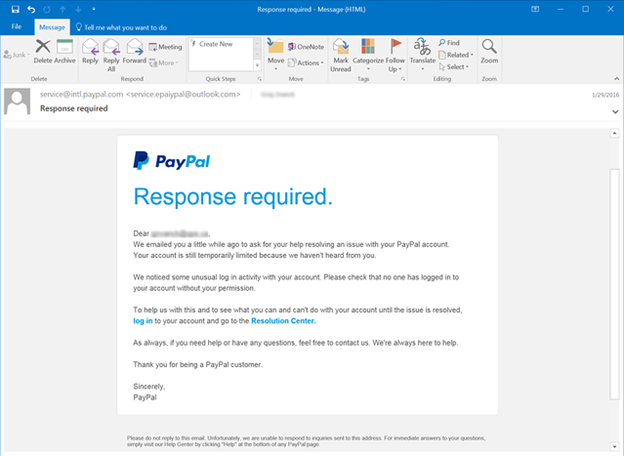
For example, an attacker might create an email that looks like it comes from PayPal. The message tells the user that their account will be suspended if they don’t click a link, authenticate into the site and change the account’s password. If the user is successfully tricked and types in credentials, the attacker now has credentials to authenticate into the targeted user’s PayPal account, potentially stealing money from the user.
More complex attacks target financial employees and use social engineering and online reconnaissance to trick a targeted user into sending millions to an attacker’s bank account.
To the user, a spoofed email message looks legitimate, and many attackers will take elements from the official website to make the message more believable. Here’s an example PayPal phishing attack with a spoofed email sender:
AbdulTech Online | Email Spoofing
With a typical email client (such as Microsoft Outlook), the sender address is automatically entered when a user sends a new email message. But an attacker can programmatically send messages using basic scripts in any language that configures the sender address to an email address of choice. Email API endpoints allow a sender to specify the sender address regardless whether the address exists. And outgoing email servers can’t determine whether the sender address is legitimate.
Outgoing email is retrieved and routed using the Simple Mail Transfer Protocol (SMTP). When a user clicks “Send” in an email client, the message is first sent to the outgoing SMTP server configured in the client software. The SMTP server identifies the recipient domain and routes it to the domain’s email server. The recipient’s email server then routes the message to the right user inbox.
For every “hop” an email message takes as it travels across the internet from server to server, the IP address of each server is logged and included in the email headers. These headers divulge the true route and sender, but many users do not check headers before interacting with an email sender.
The three major components of an email are:
The sender address
The recipient address
The body of the email
Another component often used in phishing is the Reply-To field. This field is also configurable from the sender and can be used in a phishing attack. The Reply-To address tells the client email software where to send a reply, which can be different from the sender’s address. Again, email servers and the SMTP protocol do not validate whether this email is legitimate or forged. It’s up to the user to realize that the reply is going to the wrong recipient.
AbdulTech Online | Email Spoofing
Notice that the email address in the From sender field is supposedly from Bill Gates (b.gates@microsoft.com). There are two sections in these email headers to review. The “Received” section shows that the email was originally handled by the email server email.random-company.nl, which is the first clue that this email is forged. But the best field to review is the Received-SPF section—notice that the section has a “Fail” status.Sender Policy Framework (SPF) is a security protocol set as a standard in 2014. It works in conjunction with DMARC (Domain-based Message Authentication, Reporting and Conformance) to stop malware and phishing attacks.
SPF can detect spoofed email, and it’s become common with most email services to combat phishing. But it’s the responsibility of the domain holder to use SPF. To use SPF, a domain holder must configure a DNS TXT entry specifying all IP addresses authorized to send email on behalf of the domain. With this DNS entry configured, recipient email servers lookup the IP address when receiving a message to ensure that it matches the email domain’s authorized IP addresses. If there is a match, the Received-SPF field displays a PASS status. If there is no match, the field displays a FAIL status. Recipients should review this status when receiving an email with links, attachments or written instructions.
ECL Ghana | Ads
Email Spoofing and Phishing Statistics
Email clients configured to use SPF and DMARC will automatically reject emails that fail validation or send them to the user’s spambox. Attackers target people and businesses, and just one successfully tricked user can lead to theft of money, data and credentials.
It’s no wonder that phishing is one of today’s most prominent cyber attacks. Consider the following statistics:
3.1 billion domain spoofing emails are sent per day.
More than 90% of cyber-attacks start with an email message.
Email spoofing and phishing have had a worldwide impact costing an estimated $26 billion since 2016.
In 2019, the FBI reported that 467,000 cyber-attacks were successful, and 24% of them were email-based.
The average scam tricked users out of $75,000.
A common attack that uses email spoofing is CEO fraud, also known as business email compromise (BEC). In BEC, the attacker spoofs the sender’s email address to impersonate an executive or owner of a business. This attack usually targets an employee in the financial, accounting, or accounts payable departments.
Even smart, well-intentioned employees can be tricked into sending money when the request comes from someone they trust—especially an authority figure. Here are just a few high-profile examples of phishing scams:
The Canadian City Treasure was tricked into transferring $98,000 from taxpayer funds by an attacker claiming to be city manager Steve Kanellakos.
Mattel was tricked into sending $3 million to an account in China, but it was lucky enough to claw back the money when the defrauded financial executive was able to confirm that the email message was not sent by the CEO, Christopher Sinclair.
Even with email security in place, some malicious email messages reach user inboxes. Whether you’re an employee responsible for financial decisions or as someone who uses personal email at work, there are several steps you can take to avoid becoming a victim of email fraud:
Never click links to access a website where you’re asked to authenticate. Always type the official domain in your browser and authenticate directly on the site.
The steps to view email headers are different for each email client, so first look up how to view email headers for your inbox software. Then, open email headers and look for the Received-SPF section of the headers and look for a PASS or FAIL response.
Copy and paste the content of an email message into a search engine. Chances are that text used in a common phishing attack has already been reported and published on the Internet.
Be suspicious of email supposedly from an official source with bad spelling or grammar.
Avoid opening attachments from suspicious or unknown senders.
Emails promising riches—or anything else that’s too good to be true—is likely a scam.
Beware of emails that create a sense of urgency or danger. Phishing and BEC attacks often try to short-circuit recipients’ natural skepticism by suggesting that something bad will happen if they don’t act quickly. Treat email links with extra caution if the message warns of pending account closures, scheduled payment failures or suspicious activity on one of your financial accounts. Visit the website directly through your brows
Over the past few years, you’ve probably noticed people talking a lot more about the importance of teamwork and collaboration. Open-office layouts have become the norm and team productivity tools have exploded in popularity.
Some see this emphasis on open collaboration as a passing fad or a way to lower overhead. But a growing body of research confirms that when people work together, smartly, it can unleash energy that boosts creativity, productivity, engagement, communication, and efficiency.
“Each individual has unique gifts, and talents and skills,” says John J. Murphy, a specialist in business transformation and author of Pulling Together: 10 Rules for High-Performance Teamwork. “When we bring them to the table and share them for a common purpose, it can give companies a real competitive advantage.”
Teamwork is essential to a company’s success, says Murphy. OK, but what’s in it for you? Plenty. Scads of recent studies show that team members benefit just as much as the corporations they work for. Last year, the journal American Psychologist released “The Science of Teamwork” – an entire issue dedicated to the psychology of collaboration – packed with evidence that working in a team can make you smarter, more creative, and more successful.
And that’s just for starters. Here are all the unexpected ways teamwork is worth it.
10 Benefits Of Working In A Team
1. Great ideas don’t come from lone geniuses
Albert Einstein gets all the credit for discovering the theory of relativity, but the truth is that he relied on conversations with friends and colleagues to refine his concept. And that’s almost always the case.
“Behind every genius is a team,” says Murphy. “When people play off each other’s skills and knowledge, they can create solutions that are practical and useful.”
That’s why Murphy recommends the first thing you need to do is to ditch the too-pervasive idol mentality. “Tom Brady is all that, but remember: he doesn’t win Super Bowls by himself.”
2. Diverse perspectives help you come up with winning innovations
According to Frans Johansson, author of The Medici Effect, some of the most innovative ideas happen at “the intersection” – the place where ideas from different industries and cultures collide.
“Most people think success comes from surrounding yourself with others that are like you,” says Johansson. “But true success and breakthrough innovation involves discomfort. Discomfort pushes you to grow. This is where difference of experience, opinion, and perspective come in. Diversity is a well-documented pathway to unlocking new opportunities, overcoming new challenges, and gaining new insights.”
A recent report from the consulting firm McKinsey & Company backs this up. It found teams made up of members from diverse backgrounds (gender, age, ethnicity, etc.) are more creative and perform better by up to 35 percent, compared to more homogeneous teams. Instead of looking at an issue from your individual vantage point, you get a 360-degree picture, which can lead to an exponential increase in ideas.
Research from Tufts University suggests that just being exposed to diversity can shift the way you think. A study on a diverse mock jury found that interacting with individuals who are different forces people to be more open minded, and to expect that reaching consensus will take effort.
3. Teamwork can make you happier
We surveyed more than 1,000 team members across a range of industries and found that when honest feedback, mutual respect, and personal openness were encouraged, team members were 80 percent more likely to report higher emotional well-being. Having happy employees is a worthwhile goal in itself, but the company benefits, too. Research from the University of Warwick in England suggests happy employees are up to 20 percent more productive than unhappy employees. And who couldn’t benefit from a happiness boost?
4. When you work in a team, you grow as an individual
There may be no “I” in team, but being part of a team can help you grow. “By sharing information and essentially cross training each other, each individual member of the team can flourish,” says Murphy. You might discover new concepts from colleagues with different experiences. You can also learn from someone else’s mistakes, which helps you sidestep future errors.
ECL Ghana | Team Work
You might even learn something new about yourself, says Susan McDaniel, PhD, a psychologist at the University of Rochester Medical Center and one of the guest editors of “The Science of Teamwork”.
“We all have blind spots about our behaviors and strengths that we may be unaware of, and feedback from a team member can expose them,” she says. Recognizing these strengths and addressing the weaknesses can make you a better team member, and even a better person. “Maybe working in a team you’ll discover you could be a better listener. That’s a skill you can grow in, and then take home and use to improve your family interactions,” McDaniel points out.
5. Sharing the workload eases burnout
A recent Gallup study of nearly 7,500 full-time employees found that 23 percent of employees feel burned out at work very often or always. Another 44 percent say they sometimes feel this way. What helps? Sharing the load.
Team members can provide emotional support to each other because they often understand the demands and stress of completing work even better than managers, says Ben Wigert, lead researcher for Gallup’s workplace management practice. Managers reading this: you’re not off the hook. The study also found that knowing your boss has your back also protects against burnout.
6. Dividing the work lets you grow your skills
Collaboration in the workplace isn’t unlike teamwork on the baseball diamond. When the pitcher and outfielders each excel at their individual roles, the team has a better chance of winning.
Off the playing field, that idea is more important than ever. Changes in technology and increased globalization mean that organizations are facing problems so complex that a single individual simply can’t possess all the necessary knowledge to solve them, says Wigert. When team members use their unique skills to shine in their own roles, it creates an environment based on mutual respect and cooperation that benefits the whole group, notes Murphy.
7. Recognition from other team members can improve your productivity
Getting a pat on the back from the boss can boost an employee’s motivation, but receiving kudos from a team member may be even more effective. The 2014 TINYpulse Employee Engagement and Organizational Culture Report surveyed more than 200,000 employees. Participants reported that having the respect of their peers was the #1 reason they go the extra mile at work.
8. Working in a team helps you take risks that pay off
When you work alone, you might be hesitant to put your neck on the line. What if an idea you suggest falls flat? When you work on a team, you know you have the support of the entire group to fall back on in case of failure. That security typically allows teams to take the kind of risks that create “Eureka!” ideas.
But here’s one place where size does matter. The most disruptive ideas often come from small teams, suggests recent research in the journal Nature, possibly because larger teams argue more, which can get in the way of coming up with those big ideas.
There’s no definitive ideal small team size, but consider following Amazon CEO Jeff Bezos’ 2 Pizza Rule: no matter how large your company gets, teams shouldn’t be larger than what two pizzas can feed.
9. When you work in a team, you’ll feel less stressed
If your team has good energy – you encourage and inspire each other, and you have fun together – you’ll feel less stressed, says Murphy. “Studies show that stress makes us stupid, and leads us to make more mistakes,” says Murphy.
Stale solutions often come out of working in a vacuum. When people with different perspectives come together in group brainstorms, on the other hand, innovative ideas can rise to the surface – with one caveat. Research shows this can only happen when communication within the team is open and collaborative, notes Wigert. The most creative solutions can only come up when there’s a level of trust that lets team members ask ‘stupid’ questions, propose out-there ideas, and receive constructive criticism.
It’s easier to succeed when you have clearly defined objectives that are based in reality.
The SMART in SMART goals stands for Specific, Measurable, Achievable, Relevant, and Time-Bound.
Defining these parameters as they pertain to your goal helps ensure that your objectives are attainable within a certain time frame. This approach eliminates generalities and guesswork, sets a clear timeline, and makes it easier to track progress and identify missed milestones.
An example of a SMART-goal statement might look like this: Our goal is to [quantifiable objective] by [timeframe or deadline]. [Key players or teams] will accomplish this goal by [what steps you’ll take to achieve the goal]. Accomplishing this goal will [result or benefit].
How to write SMART goals
Let’s use Jane’s objective to work through each component.
S: Specific
In order for a goal to be effective, it needs to be specific. A specific goal answers questions like:
What needs to be accomplished?
Who’s responsible for it?
What steps need to be taken to achieve it?
Thinking through these questions helps get to the heart of what you’re aiming for.
ECL Ghana | Smart Goals
M: Measurable
Specificity is a solid start, but quantifying your goals (that is, making sure they’re measurable) makes it easier to track progress and know when you’ve reached the finish line.
A: Achievable
This is the point in the process when you give yourself a serious reality check. Goals should be realistic — not pedestals from which you inevitably tumble. Ask yourself: is your objective something your team can reasonably accomplish?
Safeguarding the achievability of your goal is much easier when you’re the one setting it. However, that’s not always the case. When goals are handed down from elsewhere, make sure to communicate any restraints you may be working under. Even if you can’t shift the end goal, at least you can make your position (and any potential roadblocks) known up-front.
R: Relevant
Here’s where you need to think about the big picture. Why are you setting the goal that you’re setting?
ECL Ghana | Advertisement
T: Time-bound
To properly measure success, you and your team need to be on the same page about when a goal has been reached. What’s your time horizon? When will the team start creating and implementing the tasks they’ve identified? When will they finish?
SMART goals should have time-related parameters built in, so everybody knows how to stay on track within a designated time frame.
Knowing how to set goals using the SMART framework can help you succeed in setting and attaining goals, no matter how large or small.
Want to make it even easier? Download a SMART goals template from our friends at HubSpot.